From understanding the need to production
How I work
I start with your needs, experiment and build in small steps. Across AI and web development, I aim to make decisions clear, progress visible and results verifiable.
01 / Working together
Making progress, one step at a time.
Understand the need
We clarify goals, use cases, constraints and success criteria. I break down the work into concrete priorities to define a useful first step.
Design and experiment
I choose an approach that fits the context and test assumptions with a prototype when needed. For AI projects, this also means examining the data and evaluation criteria.
Build in small steps
I build in small increments, with tests suited to the expected behaviour and risks. Regular check-ins give us opportunities to review progress and adjust what comes next.
Deliver and support
I prepare deployment, useful documentation and handover. Feedback from real use then informs fixes and further improvements, within the support we agree on.
02 / The development approach
Informed by Extreme Programming.
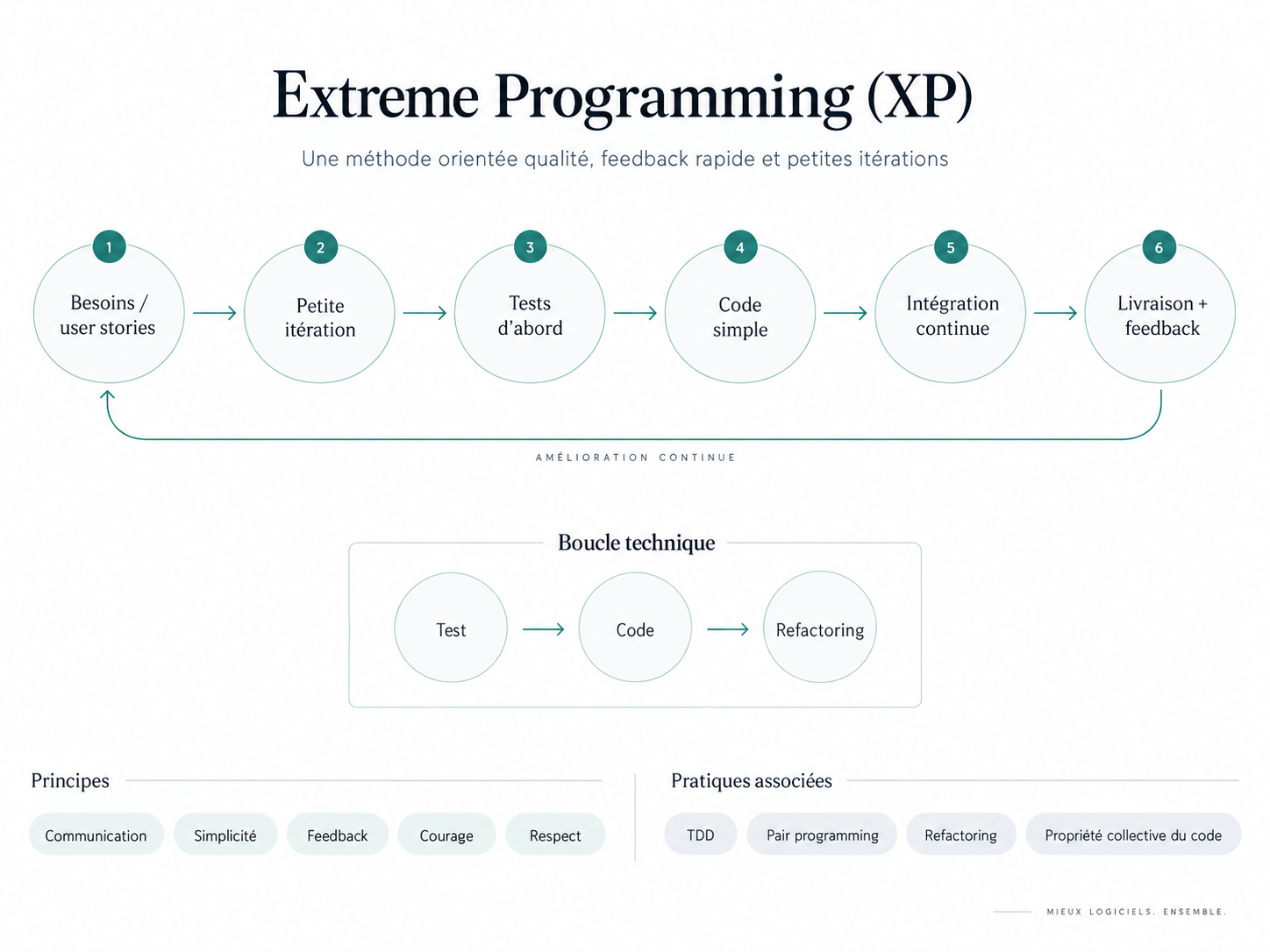
My approach draws on Extreme Programming (XP): short iterations, frequent conversations and continuous attention to software quality. Each step should produce something we can review and improve.
- Concrete needs and small releases to get useful feedback quickly.
- Tests to clarify expected behaviour and make changes with confidence.
- Simple code, improved gradually through refactoring and integrated frequently.
 Open the full-size diagram
Reading the diagram
Six steps connect the initial need to user feedback. Within each iteration, the test → code → refactoring cycle helps verify and improve the solution. Communication, simplicity, feedback, courage and respect guide this work.
I adapt these practices to the project and team. The diagram also introduces XP’s values and team practices, such as pair programming; their use depends on how we work together.
Extreme Programming practices03 / Version control
Git, with short-lived branches.
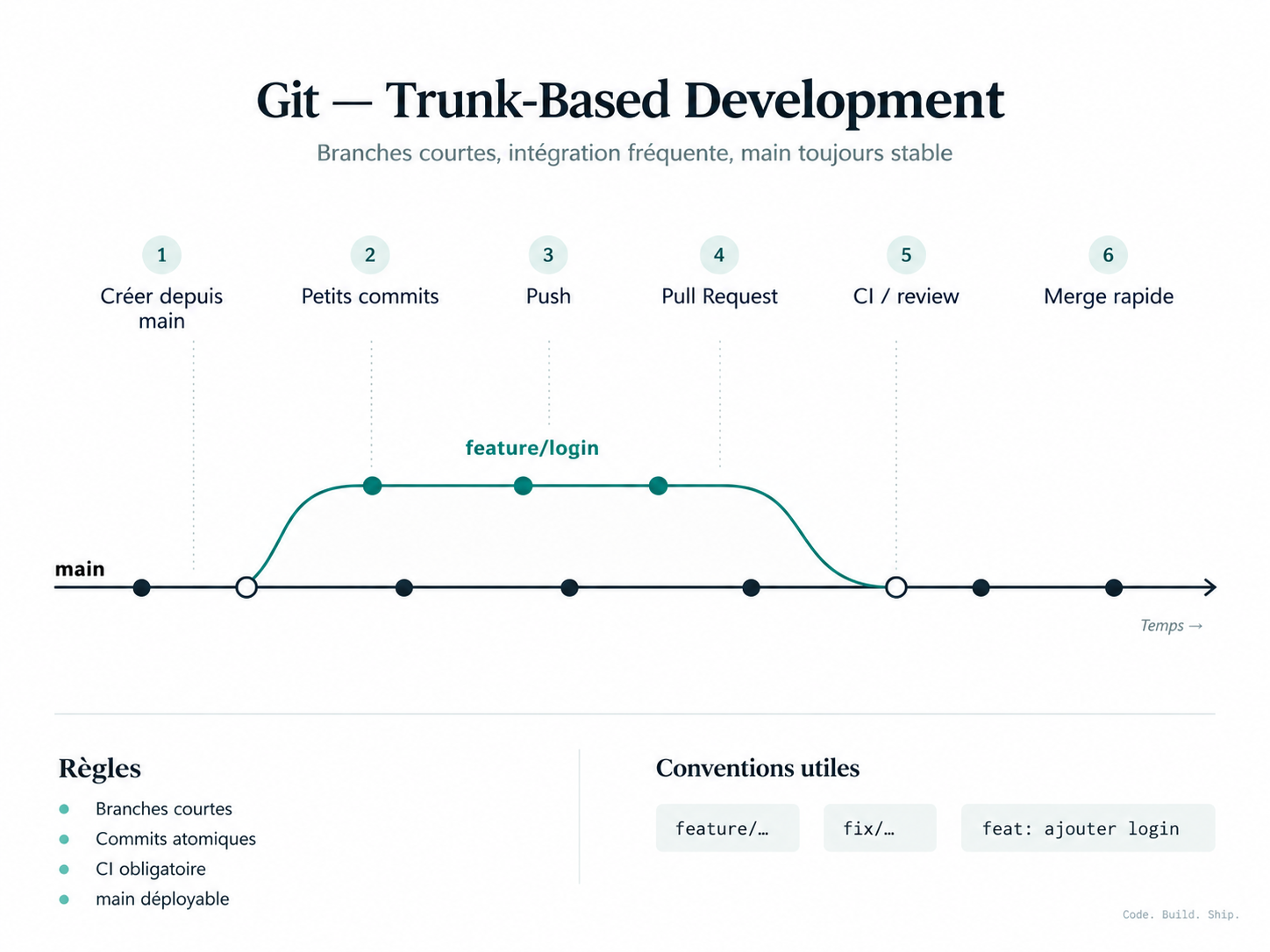
To track code changes, I favour a Trunk-Based Development workflow with Git: one reference branch, main, and short-lived working branches that are integrated frequently.
- A small change branched from main, with focused commits that each describe a specific evolution.
- A pull request to explain the change, run automated checks (CI) and support code review.
- A prompt merge after validation, with the aim of keeping main stable and deployable.
 Open the full-size diagram
Reading the diagram
Branch from main → make small commits → push → open a pull request → run CI and review → merge promptly. Branches stay short-lived, commits focused and main deployable.
This rhythm keeps changes easy to review and limits divergence between branches. Naming conventions and validation rules are agreed to suit the project.
How short-lived branches work04 / Working with Codex
Developing with Codex, staying in control.
I delegate a substantial share of code production to Codex while leading the goals, architecture and key technical decisions. I define the scope, examine the results and remain responsible for the quality of the software I deliver.
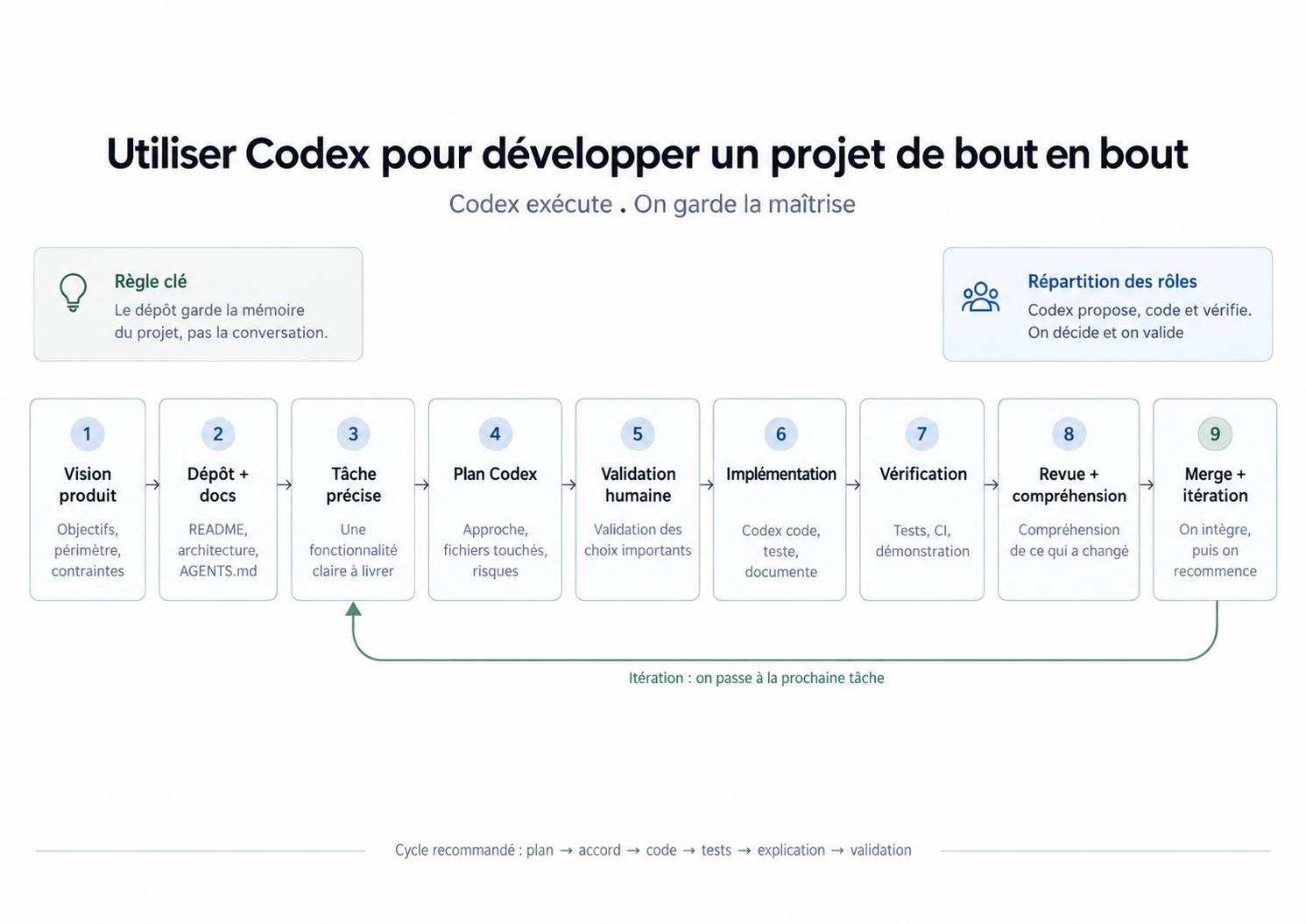
- The repository holds the project’s memory: code, README, architecture documentation, AGENTS.md instructions, decisions and current progress remain available between sessions.
- I break the work into small tasks with observable outcomes and organise sessions around a specific feature.
- Before a structural change, Codex proposes a plan for my approval. It can then carry out the task autonomously within the agreed scope.
- I ask for evidence suited to the change: tests actually run, CI results or a demonstration, together with an explanation of what changed.
 Open the full-size diagram
Reading the diagram
Product vision → repository and documentation → specific task → Codex plan → human approval → implementation → verification → review and understanding → merge and iterate. The loop returns to defining the next task. The repository preserves the project’s memory; Codex executes within an agreed scope while I retain control of decisions and integration.
Significant changes go through a review session separate from implementation. Before integration, I read the code, verify the results and make sure I understand the decisions and their consequences. Codex proposes, codes, tests and documents; I decide and validate.
Codex in the OpenAI documentationYour project
Let’s start with what you need.
A goal, an idea to test or a system to improve: let’s discuss the first step.
Let’s discuss your project